
GVNL Perspective Online


Innovation as the key to transition
The scale-up of green hydrogen depends on innovation. Without sufficient cost reductions and effective risk mitigation, financing and investment will not materialise.
When we speak about innovation in green hydrogen, this does not only concern technological breakthroughs. Of course, much attention is devoted to improved electrolysers, more efficient storage and transport, and new applications. At the same time, innovation also relates to system integration: connecting hydrogen with wind and solar energy, ensuring flexibility in the electricity system, and developing new business models and certification schemes that make investments possible. In addition, innovation includes the creation of societal support and appropriate regulatory frameworks. Innovation in green hydrogen therefore spans technology, markets, materials and people.
The long road of transistion
There is still much to be done before we can fully benefit from the advantages of large-scale deployment of green hydrogen. At the same time, transition is inherently a bumpy road, warns Nienke Homan, Director of Impact Hydrogen and Chair of the Royal Association of the Dutch Chemical Industry (VNCI): “The difficulty is that we are still thinking in terms of the existing energy system. The organisation of the oil and gas industry has developed over a period of 60 to 70 years. It is therefore an illusion to think that we can reorganise this system for green hydrogen within just a few years. At the same time, in the Netherlands we must be careful to calculate and assess actions, but not to ‘over-calculate’ them in a way that slows down progress. When the gas pipeline network was built 70 years ago, it was also impossible to calculate everything in advance. It was simply done.”
Jörg Gigler, Director of TKI Nieuw Gas (part of Topsector Energy), also underlines the importance of an action-oriented approach: “Innovation in China is currently developing very rapidly, because they follow the plans set by the Communist Party and simply implement them. How we compare to this is another question, but that aside. I can also be envious of the NEOM project. The government of Saudi Arabia invests and enables the construction of electrolysers. In the Netherlands, we often engage in lengthy discussions about whether or not we should take action.”
Nevertheless, Gigler remains optimistic that the Dutch electrolyser market will take off within the next ten years: “For this, innovation is essential and subsidies are indispensable. How do we make electrolysers cheaper, more robust and more efficient? How do we make them smaller, without using environmentally harmful substances?” Ed Buddenbaum also expects breakthroughs in electrolyser performance: “In particular in start-up and shut-down behaviour, so that electrolysis can absorb the variability in the supply of renewable electricity. In addition, I hope that projects will teach us which hydrogen carriers offer the greatest potential, so that we can focus our efforts on those.”
Innovation in practice: learning from projects
Substantial effort is being invested in technological innovation. Innovation in green hydrogen is not limited to theory: in the Netherlands, a range of projects is already generating valuable new knowledge.
HyNetwork has prepared the first pipelines for hydrogen infrastructure. PosHYdon, located on an offshore platform in the North Sea, is testing hydrogen production using seawater and demonstrates how existing gas infrastructure can be reused. H₂opZee goes a step further and is developing a 300–500 MW offshore electrolyser directly connected to wind farms. In the Eemshaven region, Eemshydrogen is working on a large-scale 50 MW electrolyser for industrial applications.
Companies such as the recently merged Battolyser Systems and VDL Hydrogen Systems are pioneering flexible electrolysers. XINTC has developed a unique circular electrolyser that can be scaled up through a modular design. These projects generate learning experiences that are directly applicable to future scale-up.
For the GroenvermogenNL programme, this is a key principle: learning from projects and sharing knowledge in order to accelerate the market readiness of innovations. Ed Buddenbaum, Managing Director of GroenvermogenNL, explains: “We support companies throughout the loops of the innovation cycle when innovations still require improvement at the demonstration stage. This is a costly phase. Our objective is to develop a portfolio of projects that can reach final investment decisions (FIDs).”
Gamechangers for green hydrogen
Dutch policy prioritises direct electrification as the preferred route, while recognising that green hydrogen is indispensable for hard-to-abate sectors. Innovation must make green hydrogen reliable, affordable and safe. It must also strengthen the coherence with electrification: green hydrogen can contribute to stabilising the electricity grid.
There is a strong call for a clear government vision. “Innovation is a long-term investment,” says Jörg Gigler. “Political support influences the speed of innovation. Many innovation instruments are currently secured only until 2027–2028. The Climate Fund runs until 2029. A new cabinet will have to look beyond that period. At the same time, companies need a realistic short-term perspective. Very few companies are already thinking about 2050; they want clarity for the next three to five years.”
Nienke Homan agrees: “The Netherlands needs a vision of what the country should look like in 2030 and 2040 and what role green hydrogen will play in that. We need leadership and direction from policymakers, both at national and regional level.” She argues that the social dimension has been overlooked in the transition to green hydrogen. According to Homan, the real gamechangers in innovation lie in business models and societal acceptance: “The solution is demand creation. Demand for sustainable products does not arise automatically. We have always focused on the supply side, but we also need to look at the end of the value chain and make all products more sustainable. If every product contains a certain percentage of sustainable raw materials, we create a market for sustainable resources because consumers will buy these products.”
Strong in molecules
According to Homan, this demand creation can only be achieved by government action, and preferably at European level. The Netherlands can play a major role in this: “We are strong in molecules. That is our strength: energy in molecules and electrons. Because of our long experience with natural gas in a large industrial sector, we have built up a great deal of expertise. The risk is that, as an energy country, we have become accustomed to always having access to energy. While other countries embrace the opportunity to build a new energy system and make it sustainable from the outset, we have to break away from the existing system. With our large industrial base, we also have much to lose if these industries are unable to decarbonise.”
Gigler is convinced that green hydrogen plays a key role in the current political landscape: “For some time, climate and CO₂ reduction were at the top of the political agenda. These themes have now dropped to third place, with autonomy and earning capacity in first and second place. This results in a retreat from sustainable investments. We see, for example, that industry is leaving Europe because production is cheaper elsewhere and subject to fewer requirements. By developing green hydrogen intelligently through innovation, we can address all three themes: autonomy, earning capacity and climate. We can secure a position in the global market through domestic production based on wind and solar energy. Our manufacturing industry, which produces electrolysers, strengthens independence, security of supply and earning capacity. And finally, it also reduces CO₂ emissions.”
It must be truly green
The greatest innovation efforts lie in making business cases bankable through cost reductions and improved contract models. Breakthroughs are needed in circular and PFAS-free electrolysers, so that the Netherlands and Europe become less dependent on vulnerable raw material supply chains.
Much more experience must also be gained in import and conversion, particularly for ammonia and other hydrogen carriers. In addition, policy can further accelerate developments by improving permitting procedures, infrastructure and tariff structures, and by rewarding flexibility. “In legislation and regulation, we should also seek gradual implementation,” says Gigler. “If I could change one thing today, it would be the overly strict definition of what counts as green hydrogen. These strict rules are constraining. Hydrogen is required to be extremely green. For example, keeping an electrolyser running by also using electricity from the grid is not allowed, even though this might improve the affordability of the technology. A second adjustment that would help us greatly is faster permitting. You should not have to wait a year for a permit. And finally, pricing instruments are essential to make sustainable alternatives more attractive. As long as there is no viable business case for green hydrogen, public funding will be needed.”
95 % blood, sweat and tears
The Netherlands is working on the entire green hydrogen system through innovation. Government provides substantial subsidies, which remain necessary as long as there is no viable business case. Companies are not charitable institutions, Homan notes. Sometimes innovation takes the form of a small technical improvement, sometimes of a process change. Sometimes it concerns cooperation, sometimes social acceptance or legislation and regulation. Buddenbaum explains: “In the Netherlands, innovation takes place at all levels. These are not always major, visible breakthroughs, but often small steps — 95% blood, sweat and tears and 5% inspiration. To the outside world they may sometimes seem insignificant, but it is precisely these small steps that generate the lessons that ultimately lead to real breakthroughs.”
“95% blood, sweat and tears and 5% inspiration”
“the transition is inherently a bumpy road”
“If I could change one thing today, it would be the overly strict definition of what counts as green hydrogen”
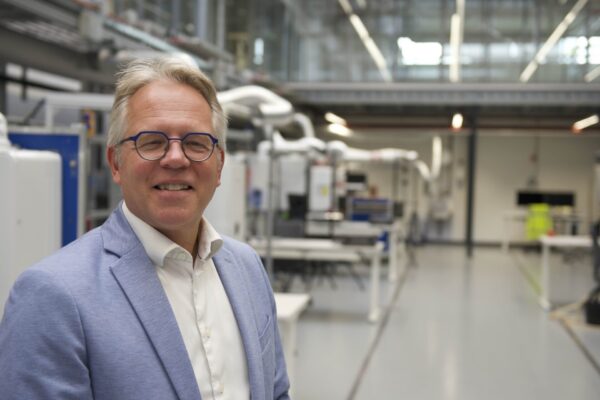
Jörg Gigler
Directeur van TKI Nieuw Gas
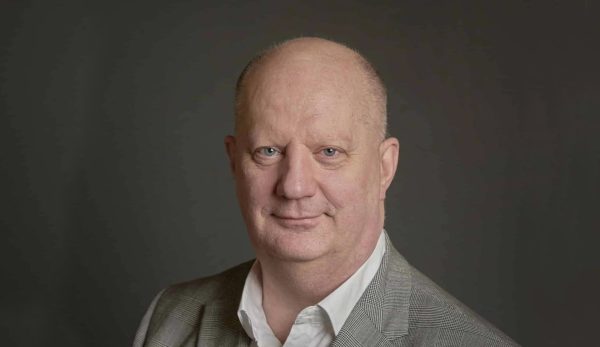
Ed Buddenbaum
Senior Programme Manager

Nienke Homan
Directeur van Impact Hydrogen en voorzitter van de Koninklijke Vereniging van de Nederlandse Chemische Industrie (VNCI)