H2 Impact Makers: Ellen van der Veer


1. What inspired you to start working on this hydrogen project, and what motivates you to keep going?
“My involvement in this hydrogen project began around three and a half years ago, when I was working as an energy transition strategist at Port of Amsterdam. Through my former manager, Eduard de Visser, I came into contact with Ellen Ruhotas, CEO of EcoLog. She was interested in exploring the import of liquid hydrogen at an existing site in the Port of Amsterdam. Together with her and TNO, I worked on an early-stage feasibility study. From there, a collaboration developed that has deepened ever since.
The potential of the project and the energy within the EcoLog team ultimately motivated me to make the move to EcoLog. I wanted not only to guide the project from a strategic perspective but also to help build it in practice. What motivates me to continue is the combination of strategic complexity and societal relevance. Hydrogen is not a simple solution, and that is precisely what makes it interesting. It touches on infrastructure, policy, technology, and human behaviour. I believe that this project contributes not only to the energy transition, but also to building trust in new forms of sustainable energy. That mission drives me every day.”
2. What challenges have you encountered during the implementation of this project, and how have you addressed or plan to address them?
“One of the biggest challenges in this project is that we are trying to obtain permits for something that has never been carried out on this scale anywhere in the world. It concerns an entirely new concept in which established, mature technologies interact in a new way. The core question is: how do you build sufficient trust, both internally and among public stakeholders, to jointly reach a permitting decision?
We addressed this challenge by engaging in dialogue with all relevant public parties right from the beginning. By now, we have been in intensive discussions about the project for more than three and a half years. Through transparency, consistency, and sharing technical insights, we have gradually built trust. This has led to a shared belief that we can realise a safe, robust, and technically feasible solution. In this way, we are making the project genuinely permit-ready.”
3. In your view, what is the project’s most significant contribution to the transition toward a sustainable hydrogen economy?
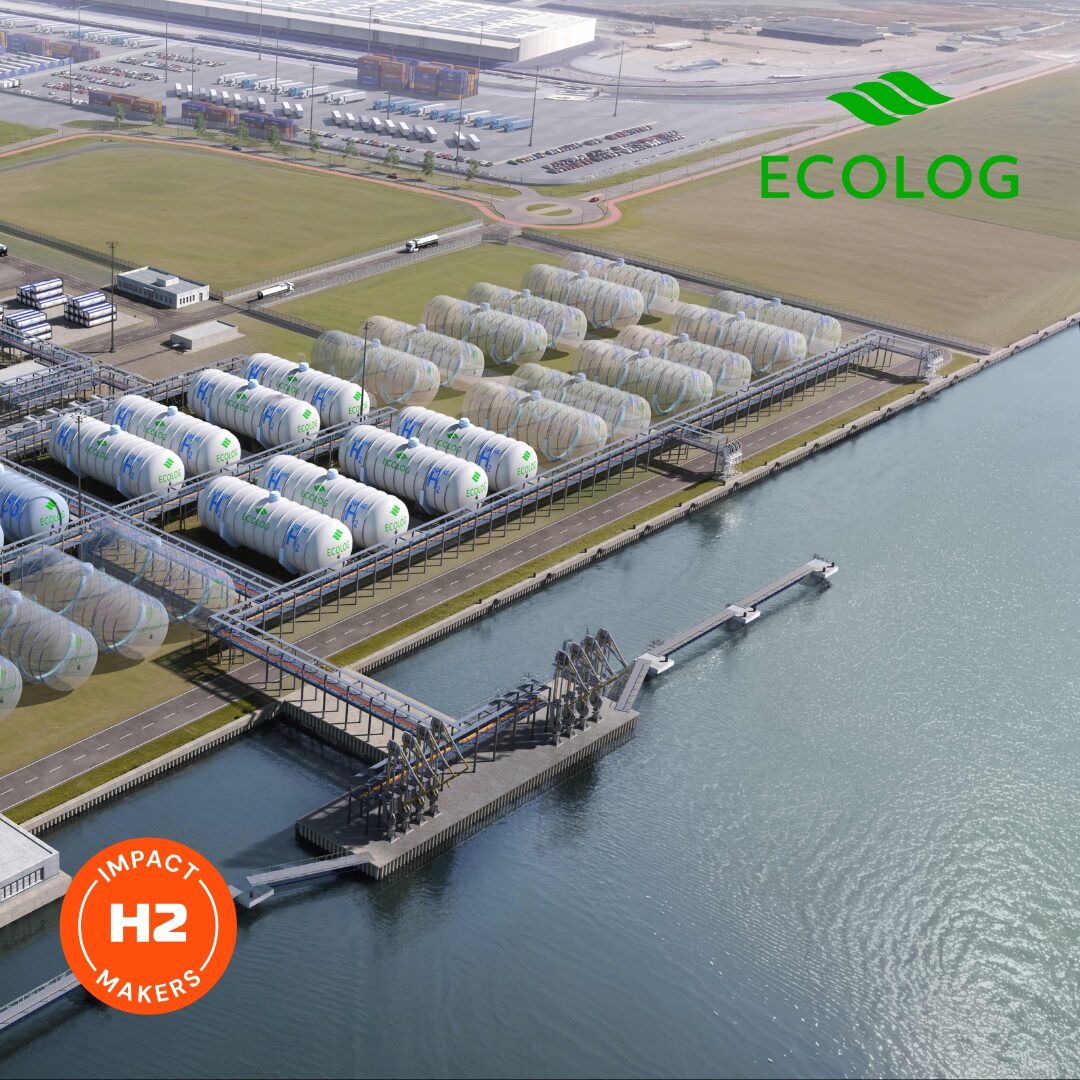
“This infrastructure project is at the heart of the development of the hydrogen economy. It enables the efficient transport of sustainable hydrogen from various parts of the world to Northwest Europe. In doing so, we are establishing a crucial link in the international hydrogen value chain and accelerating the scaling up of sustainable energy solutions.
I strongly believe that EcoLog plays a pioneering and driving role in this. We approach the project from a chain perspective: not focusing solely on production or import, but on the functioning of the entire hydrogen system. We are convinced that we can only be relevant if we effectively connect all links, from source to end user. This integrated vision makes our project both unique and impactful.”
4. What support or collaboration has played a crucial role in the progress of your project?
“Many collaborations have been essential in getting us to where we are today. One that I would like to highlight is our partnership with the Italian company Gas & Heat Spa. They are developing the storage tanks, which form a critical component of our project’s success. We are also grateful for the collaboration with other technology suppliers and hydrogen off-takers, who help us realise the full value chain. In addition, the TSE Industry subsidy awarded by GroenvermogenNL gave an important boost to the further development of our activities. That financial support enabled us to take concrete steps toward implementation.”
5. How do you see the future of hydrogen, and what role do you hope your project will play in it?
“We see that hydrogen has moved beyond the peak of its hype cycle and that we are now in a phase of realism. The appreciation for hydrogen is becoming more concrete: it is not a solution to everything, but it does play an indispensable role in decarbonising hard-to-abate sectors, such as certain industrial processes and mobility.
In almost all future scenarios, sustainable hydrogen holds a position in our new energy system, not only as a clean fuel but also as a buffer and flexibility instrument. In our case, with a storage and handling terminal, we can make a meaningful contribution. We increase system flexibility by enabling temporary storage, help balance the hydrogen network, and can deliver directly to customers. There are also pathways in which we can help alleviate grid congestion. In this way, we actively contribute to the robustness and sustainability of tomorrow’s energy system.”
“We increase system flexibility by enabling temporary storage, help balance the hydrogen network, and deliver directly to customers.”