
Almost 29,000 FTEs needed for green hydrogen


SEO Economic Research notes that investments in green hydrogen are stagnating. Commissioned by GroenvermogenNL and Platform Talent for Technology, the organisation conducted a labour market study to map labour demand for the hydrogen transition through to the end of 2030. Investments across the hydrogen value chain are an important indicator in this regard. “Many of the planned projects to build hydrogen production capacity are increasingly being postponed,” the researchers write.
28,600 FTEs through to the end of 2030
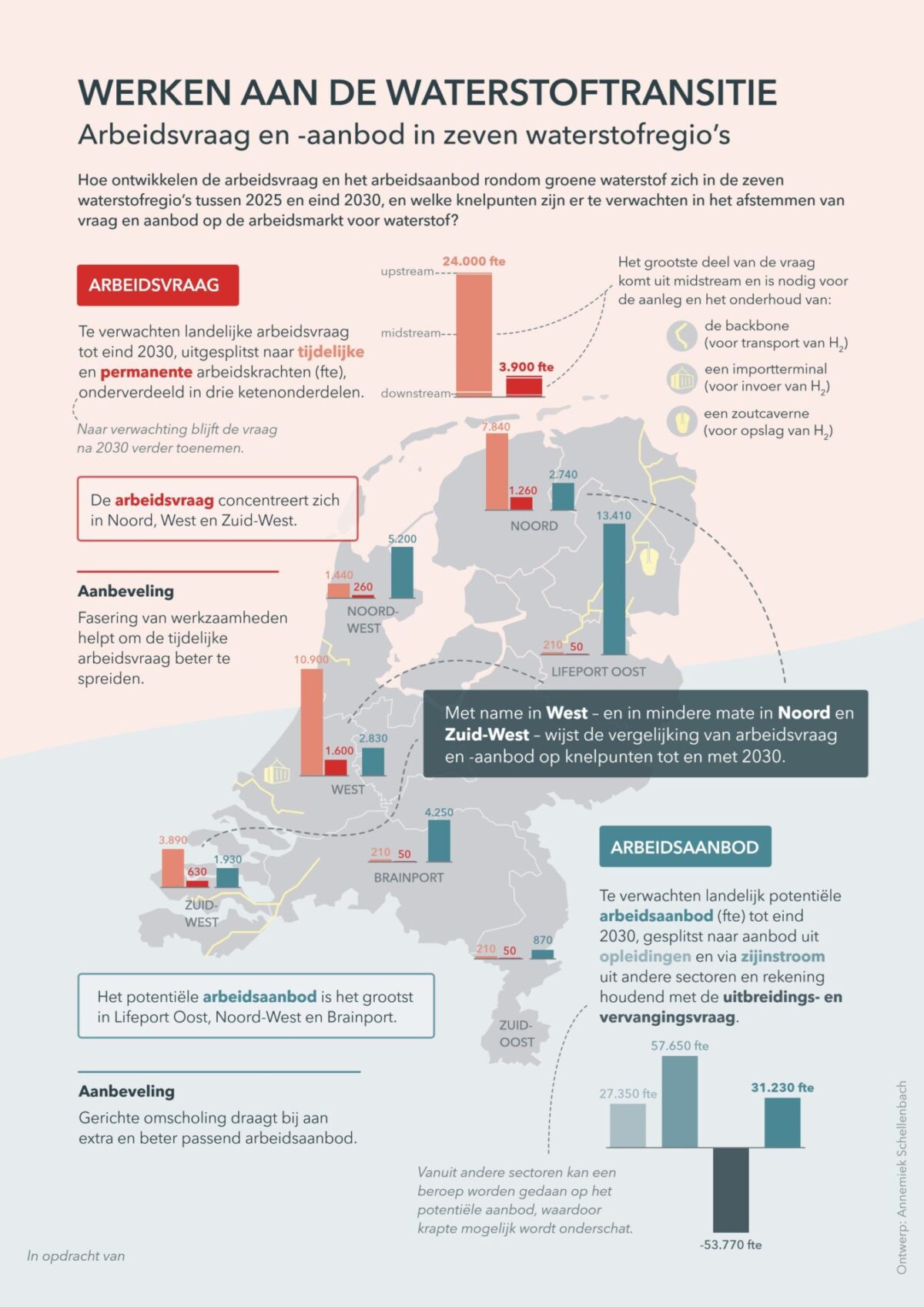
Lower investments in green hydrogen lead to lower demand for green hydrogen professionals. In a labour market study carried out by SEO Economic Research together with CE Delft in 2023, approximately 38,000 FTEs were estimated to be required for the period 2024–2030. This expectation has now been revised downwards to 28,600 FTEs through to the end of 2030, of which nearly 25,000 FTEs concern temporary positions. Training, particularly of career switchers, therefore remains urgent. Marsha Wagner, Programme Director Human Capital at GroenvermogenNL: “We cannot afford to sit back. Green hydrogen will take off sooner or later.”
Most professionals will be employed on a temporary basis, for example to develop a nationwide hydrogen infrastructure. This includes the so-called backbone: the national hydrogen network that will eventually connect all industrial clusters, hydrogen storage facilities, production sites and hydrogen infrastructure in neighbouring countries. In addition, an import terminal and a salt cavern for hydrogen storage will be required. Of the total 28,600 FTEs, 3,900 FTEs will be needed on a permanent basis.
Reskilling for career switchers
What about the number of students and graduates in programmes relevant to hydrogen-related sectors? A positive development is that enrolment in hydrogen-related programmes has increased in recent years. Those who obtain a diploma are also increasingly finding employment in hydrogen-related sectors, according to the researchers. “As a result, hydrogen-related sectors have become increasingly successful in recent years in retaining potential inflow.”
Other sectors may in fact represent the most important source of new employees for green hydrogen. These include professionals entering the sector through targeted reskilling pathways. “The large net inflow is likely to come from people transitioning from similar roles,” the researchers write, referring to sectors such as construction, business services and wholesale and retail trade.
“Learning communities offer prospects for a more flexible system that better adapts to the needs of the hydrogen economy.”
— SEO Economic Research
Regional differences
The labour market study reveals notable regional differences. Labour demand is particularly high in the three northern provinces and in South Holland, and to a lesser extent in North Holland, Flevoland, Utrecht and Limburg. The researchers expect labour shortages in some regions, especially in the northern provinces and Zeeland. The type of work also varies considerably. For example, the manufacture of plastics and chemicals is relatively prominent in Zeeland and Limburg. “For permanent labour demand, most regions primarily require workers whose highest completed education level is HAVO, VWO, MBO level 3 or MBO level 4,” the researchers note.
A better-functioning education and training system
“The various studies show that the current education and training system does not yet function optimally as an effective adjustment mechanism between labour market demand and educational supply within the hydrogen transition,” the researchers conclude. “The hydrogen education landscape is fragmented and lacks national or regional coordination. In addition, educational institutions respond slowly to changing market signals, partly due to quality assurance, accreditation processes and uncertainty about future demand.” Educational institutions tend to wait until projects are actually launched by companies. According to the researchers, learning communities offer a solution. “These collaborative initiatives provide prospects for a more flexible system that better adapts to the needs of the hydrogen economy.”
“With hydrogen, we are globally at a point of no return. Let us prepare now for the future.”
— Marsha Wagner, Programme Director Human Capital GroenvermogenNL
“Ready for the future”
Marsha Wagner, Programme Director Human Capital at GroenvermogenNL, is not surprised by the report from SEO Economic Research. “The decrease in the required number of FTEs aligns with the stagnating development of green hydrogen,” she says. “In recent years, the government has not sufficiently stimulated the market.” Nevertheless, she remains hopeful. “We are not standing still. Regions across the Netherlands are continuing to develop what we call a responsive ecosystem. This is a network in which educational institutions and companies collaborate, learn and innovate at regional level, enabling new knowledge and skills to be applied quickly and shortening the time to job.”
Recently, GroenvermogenNL approved three projects under the human capital programme to develop responsive ecosystems at regional level. “This is necessary because we must be ready for the moment when the development of green hydrogen accelerates,” Wagner says. “At that point, we must also be able to rapidly train the workforce in the Netherlands to meet labour demand. That is what we are preparing for with GroenvermogenNL, for example by stimulating the development of individual growth pathways for working professionals, and by establishing a national knowledge platform so that regional knowledge can be shared and standardised nationwide.”
“We cannot afford to sit back,” Wagner concludes. “Green hydrogen will take off sooner or later. Consider the plans for a new cabinet, in which green hydrogen once again plays a role, or the EU targets for the production and import of green hydrogen by 2030. In a few years’ time, the world may look very different. It is crucial that innovative entrepreneurs who are taking risks today are given sufficient space, and that their start-ups are not stifled because there are no people available to do the work. With hydrogen, we are globally at a point of no return. Let us prepare now for the future with green hydrogen.”