
Public acceptance of industrial hydrogen developments


Although public perceptions of hydrogen are increasingly being studied, relatively little is still known about the acceptance of industrial applications of green hydrogen. A team of researchers from Leiden University, the University of Groningen and the University of Amsterdam reviewed the available knowledge and published the report ‘An overview of factors influencing public acceptance of industrial hydrogen developments’. The report provides an overview of the factors influencing public acceptance of industrial hydrogen projects. Drawing on social science research, the researchers have brought together existing knowledge in a practical framework that illustrates how technical, social, spatial and procedural factors shape public perceptions of hydrogen. The report also identifies areas where further research is needed.
Four factors influencing public acceptance
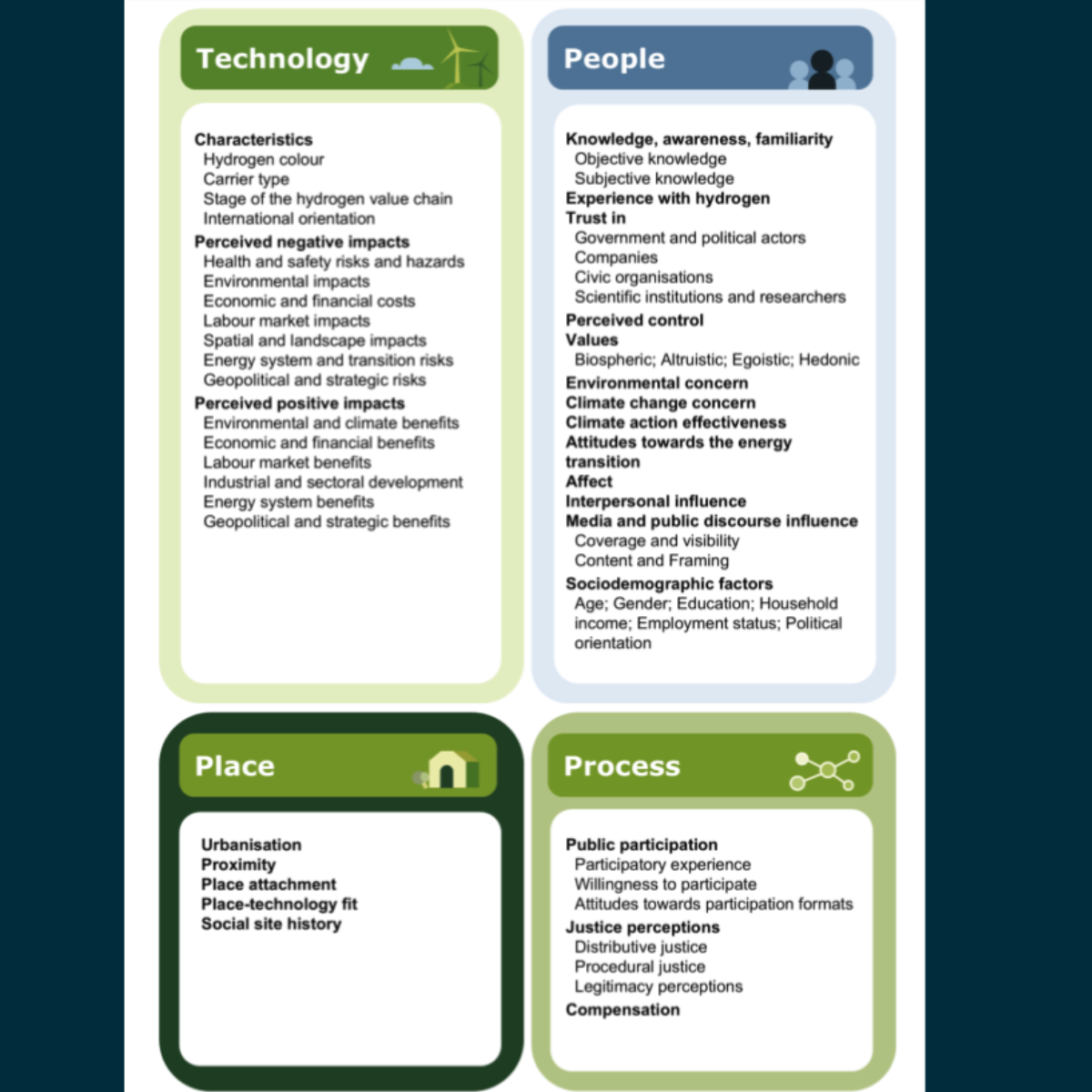
Public acceptance is often assumed to be simply a matter of informing people about a new technology. However, the report shows that the reality is much more complex. The researchers identified a range of factors that can influence public acceptance and grouped them into four interconnected domains:
-
Technological factors, such as perceived risks, benefits and the characteristics of the hydrogen system.
-
Human factors, including trust, knowledge, values, emotions and sociodemographic characteristics.
-
Place-based factors, such as the local context and people’s attachment to their living environment.
-
Process-related factors, including public participation, fair decision-making and compensation.
Public acceptance therefore involves much more than simply understanding the technology. It results from the interplay between technical and societal factors.
What do we know so far?
The report analysed European studies on public acceptance of industrial hydrogen developments. Only 21 studies met the selection criteria, highlighting that this is still a relatively new field of research.
Most studies focus on topics such as trust, knowledge and perceptions of risks and benefits. Much less is known about the influence of local conditions, decision-making processes and the characteristics of hydrogen systems. These areas offer important opportunities for further research.
Implications for policy and practice
The report shows that public acceptance cannot be reduced to a single issue, such as safety or economic benefits. The factors involved vary depending on the project, location and stage of development. It is therefore important to incorporate societal perspectives from the very beginning of hydrogen project development. Trust in project developers and public authorities, careful decision-making and consideration of local interests are just as important as the technical performance of the system.
Further research within HySUCCESS
The next phase of the HySUCCESS project will focus on identifying which factors have the greatest influence, how they interact and how public acceptance evolves over time. This research will involve periodic surveys and choice experiments, among other methods.
By combining social, technical, legal and economic insights, HySUCCESS aims to contribute to hydrogen systems that are not only technically feasible and economically viable, but also supported by society.
HySUCCESS R&D project
GroenvermogenNL is committed to scaling up and accelerating the production and use of green hydrogen. Through our R&D programme, we promote innovation and collaboration between research institutions and industry. Within this programme, HySUCCESS focuses specifically on public support, which is essential for a successful hydrogen transition.
A consortium of 10 universities, 5 universities of applied sciences, 1 research institute, 3 industrial partners and 1 industry association aims to provide a comprehensive overview of the socio-economic factors influencing the role of green hydrogen in a sustainable energy system, supported by €12 million in funding.
Read the full report: ‘An overview of factors influencing public acceptance of industrial hydrogen developments’.