H2 Impactmakers: Rik van Gorp, PhD candidate at Eindhoven University of Technology


What inspired you to start working on this hydrogen project, and what motivates you to keep going?
“Our goal is to develop an electrolyser that is efficient, scalable and affordable. Initially, we focused on components for hydrogen fuel cells. However, conversations with the market revealed that customers were facing bigger challenges, particularly the upcoming ban on PFAS and the high cost of green hydrogen. For me, that was a turning point: how can we develop solutions to these broader challenges that are also scalable and financially viable?”
“This led us to our membraneless electrolyser. The technology is still at an early stage. That is why I will be pursuing my PhD on this topic, with the aim of further developing the technology in a spin-off after completing my PhD. What motivates me is precisely this interaction between science and the market. It is not about doing research for the sake of research, but about building technology that solves a real industrial problem and can contribute to our energy transition.”
What challenges have you encountered while carrying out this project, and how have you overcome them?
“By engaging with potential customers early on and on a regular basis, we were able to adjust our focus in time and address a challenge that truly matters. From a technical perspective, the biggest challenge is demonstrating a long operational lifetime and scaling up the technology. In theory, we know it can be done, but we now need to demonstrate this in practice. That is the phase we are currently in: proving step by step that what works at lab scale remains reliable at an industrial scale.”
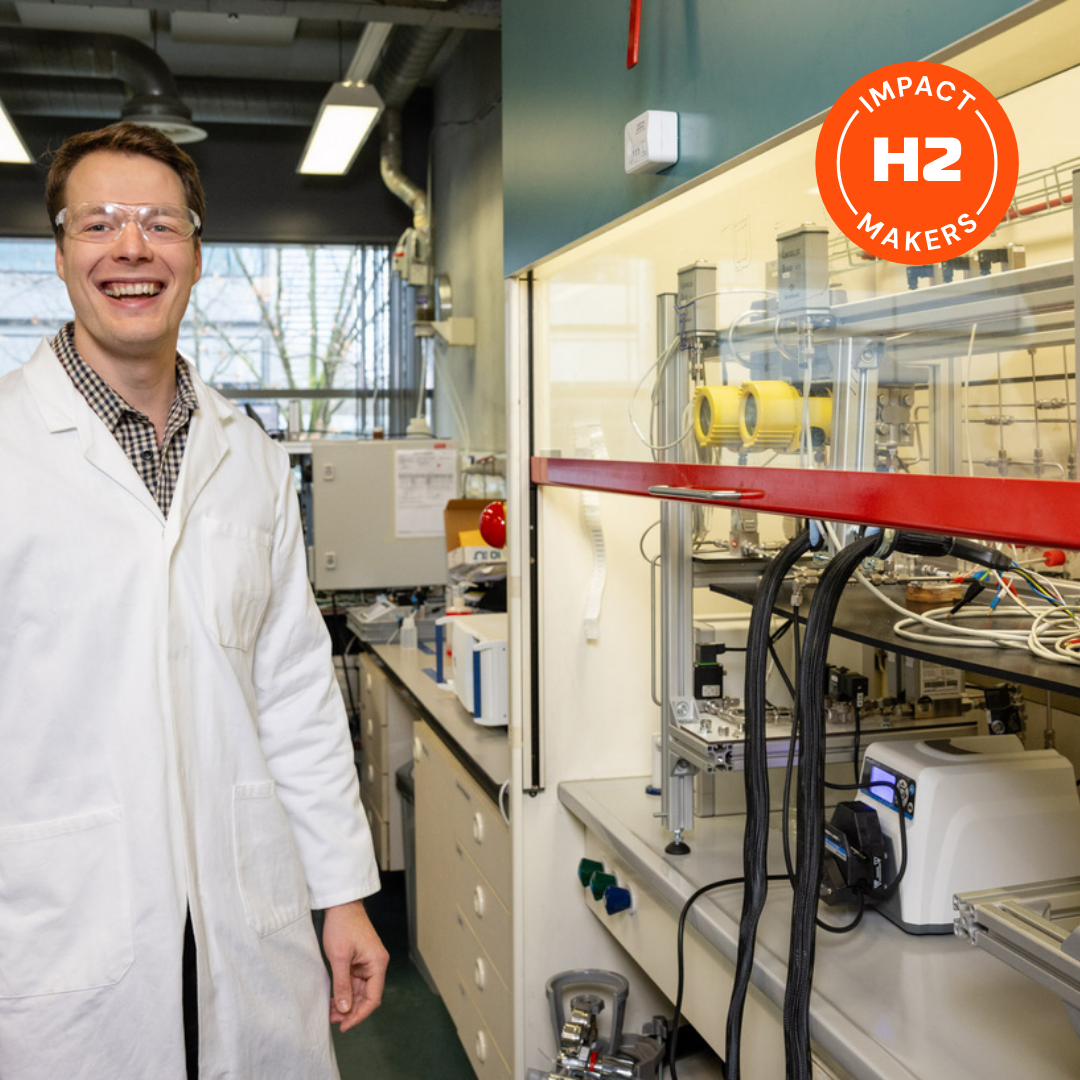
What do you see as the biggest contribution this project makes to the transition towards a sustainable hydrogen economy?
“We are working on a scalable way to produce green hydrogen using widely available, everyday materials and without the most vulnerable component found in existing systems: the membrane. Our architecture enables efficient production in a compact, simple system that is suitable for industrial scale-up and mass manufacturing. This makes large-scale industrial hydrogen production possible at lower costs, particularly for the sectors that need green hydrogen most.”
What support or collaboration has played a crucial role in the success of your project?
“The foundation of our work lies within the research group of Prof. Dr Antoni Forner-Cuenca at Eindhoven University of Technology, where we conduct research into innovations that will shape our future energy system. In addition, the Faculty of Impact programme and GroenvermogenNL’s Ideation Lab programme have been crucial in helping us take the step from research to application. The Impact Studio at Delft University of Technology has supported us with the commercial development. The Gate, the regional hub for start-ups, and the TTT Fund (Thematic Technology Transfer scheme, ed.) play an important role as we move towards establishing the spin-off. Equally valuable have been our conversations with potential customers. They have helped us identify the real problem and ensure that we are developing for the market rather than for the lab.”
How do you see the future of hydrogen, and what do you hope your project can contribute to it?
“Green hydrogen will become indispensable for decarbonising industry, particularly in areas where direct electrification is not an option. The biggest barrier is still cost. Many innovations in electrolysis improve one aspect at the expense of another: efficiency at the expense of compactness, or simplicity at the expense of performance. I hope our project can eliminate the need to make those trade-offs by combining simplicity and scalability without relying on scarce or vulnerable materials. If, as a spin-off, we can help bring about the point at which green hydrogen becomes competitive with fossil alternatives, then we will have made the impact we set out to achieve.”
Gerelateerd nieuws
H2 Impactmakers: Aldwin Oechies, Operations Manager at Holthausen Energy Points
Behind every hydrogen project is a story of ambition, challenges and hope for the future. We speak with project leaders, CEOs, researchers and other pioneers to discover what drives them, what lessons they have learned and how they are contributing to a sustainable hydrogen economy. We asked Aldwin Oechies, Operations Manager at Holthausen Energy Points, five questions.
H2 Impact Makers: Ellen van der Veer
“This infrastructure project is at the heart of the emerging hydrogen economy.” Behind every hydrogen project lies a story of ambition, challenges, and hope for the future. In the H2 Impact Makers series, GroenvermogenNL asks project leaders, CEOs, researchers, and other pioneers what drives them, what lessons they are learning, and how they contribute to a sustainable hydrogen economy. Five questions for Ellen van der Veer, Development Lead of the EcoLog Terminal Amsterdam, which received €4 million in TSE Industry Studies (Hydrogen and Green Chemistry) for an environmental assessment.