
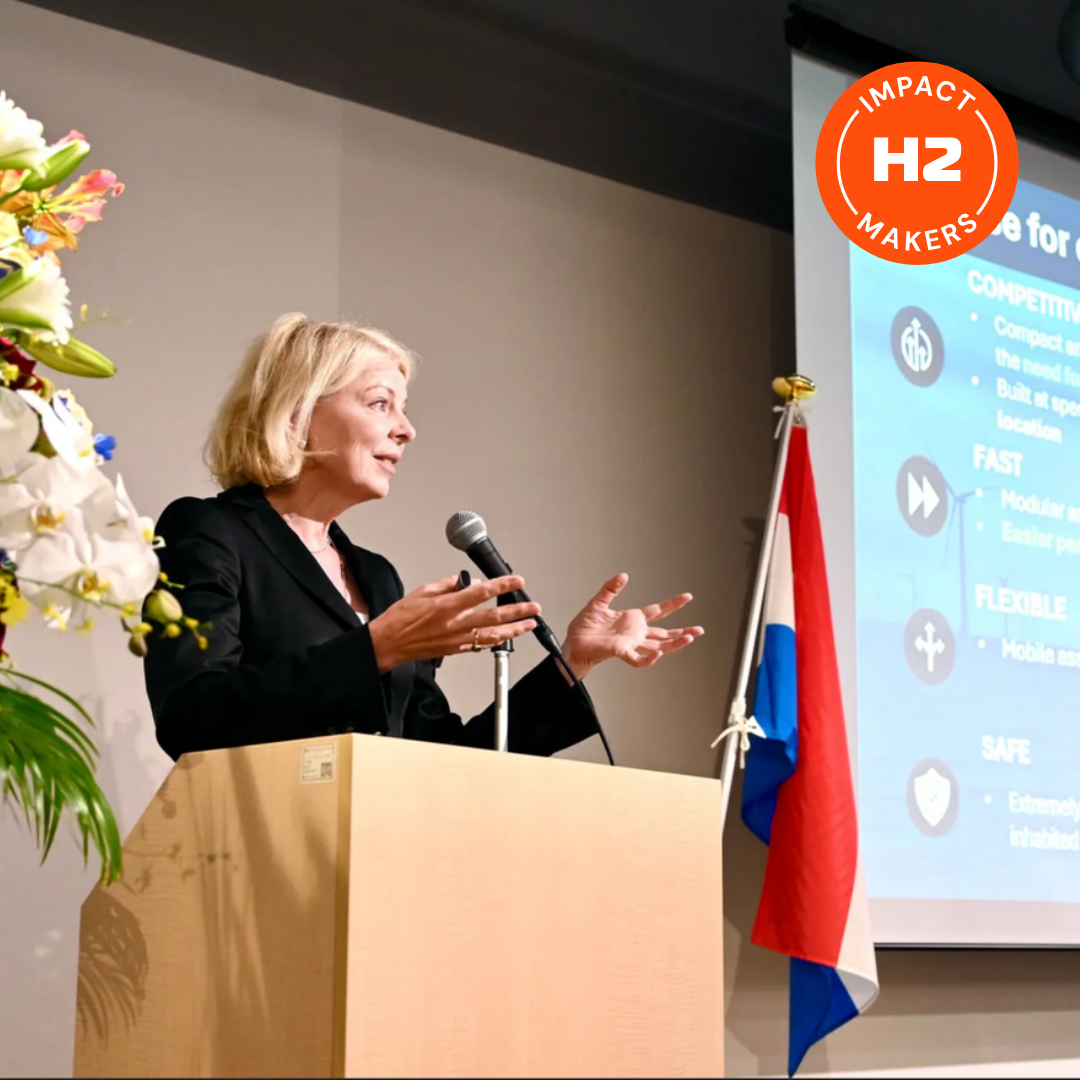
H2 Impactmakers: Saskia Kunst, CEO of SwitcH2


What inspired you to start this hydrogen project, and what motivates you to keep going?
“At SwitcH2, we are developing FPSOs: Floating Production, Storage and Offloading units. These are floating platforms designed to produce, store and offload hydrogen or ammonia at sea. This concept has been used in the oil and gas industry for decades. I have extensive experience in this sector, including offshore operations and the international port industry, and became involved in sustainability and renewable energy early on. This led me to connect with naval architect Bob Rietveldt. Together, we founded SwitcH2 to transform existing FPSO technology into floating hydrogen production facilities.”
What challenges have you encountered during the implementation of this project, and how have you overcome them?
“With our technology, we pump up seawater, desalinate it and produce hydrogen through electrolysis. We can also extend the process by combining hydrogen with nitrogen from the air to produce ammonia. From a technological perspective, we have encountered relatively few challenges, thanks to our highly skilled and experienced partners. Our main focus has been on optimising existing technologies.
However, we have noticed a shift in investor sentiment since the hydrogen hype five years ago, when we started SwitcH2. At the same time, the urgency to invest in renewable energy has increased. The current geopolitical situation has heightened the need for security of supply in the Netherlands and Europe. Each of our FPSOs, with a capacity of 300 MW, can produce a quarter of a million tonnes of ammonia or 40,000 tonnes of hydrogen annually. These are significant volumes.”
What do you see as the project’s greatest contribution to the transition towards a sustainable hydrogen economy?
“Our production is both scalable and large-scale. A single FPSO can fully meet the annual hydrogen demand of one or two major industrial companies. We can produce in Europe, but also in countries such as Namibia, where ideal conditions for solar and wind energy make hydrogen and ammonia production cost-effective for import into the Netherlands.
One of the major advantages of our system is its mobility. Investment costs are roughly comparable to those of a similar onshore facility, but we can build wherever it is most cost-effective. The permitting process is simpler, and our environmental footprint is smaller. We only need a mooring system on the seabed, which can be removed when the FPSO is relocated. And because ammonia production is a well-established process that we apply offshore, we operate to very high safety standards.”
What support or collaboration has played a crucial role in the success of your project?
“From the very beginning, we have worked with a small group of highly skilled technology partners. This expertise is also reflected in our strategic partners, who contribute not only financial resources but also engineering knowledge.
The same applies to GroenvermogenNL, the Netherlands Enterprise Agency (RVO), Topsector Energie and the European Just Transition Fund. In addition to providing financial support, they challenge us to develop strong projects in Rotterdam and Portugal to demonstrate the feasibility and performance of our technology.
Last but certainly not least, I am extremely grateful for the SwitcH2 team. We work with talented, enthusiastic people who are all driven by our shared ambition to make the future of energy production more sustainable.”
How do you see the future of hydrogen, and what role do you hope your project will play in it?
“The energy transition cannot rely entirely on electrification. Hydrogen, and ammonia as a hydrogen carrier, will play an important role. Our solution aligns perfectly with the Dutch government’s vision of producing hydrogen in the North Sea while also importing it from countries where production costs are lower. We are therefore active in Namibia, Portugal and Sweden. With the scale of production we can achieve, we can make a meaningful contribution to decarbonising hard-to-abate sectors such as petrochemicals, shipping and the fertiliser industry.”
Related articles
H2 Impact Makers: Ellen van der Veer
“This infrastructure project is at the heart of the emerging hydrogen economy.” Behind every hydrogen project lies a story of ambition, challenges, and hope for the future. In the H2 Impact Makers series, GroenvermogenNL asks project leaders, CEOs, researchers, and other pioneers what drives them, what lessons they are learning, and how they contribute to a sustainable hydrogen economy. Five questions for Ellen van der Veer, Development Lead of the EcoLog Terminal Amsterdam, which received €4 million in TSE Industry Studies (Hydrogen and Green Chemistry) for an environmental assessment.
H2 Impactmakers: Karsten Dietvorst, External Partnership Specialist at Prodrive Technologies
In this edition of H2 Impactmakers, we speak with Karsten Dietvorst, External Partnership Specialist at Prodrive Technologies. He discusses the development of smart rectifiers for electrolysers, the challenges facing the green hydrogen market, and how innovation is helping to build a sustainable and resilient hydrogen economy.
